
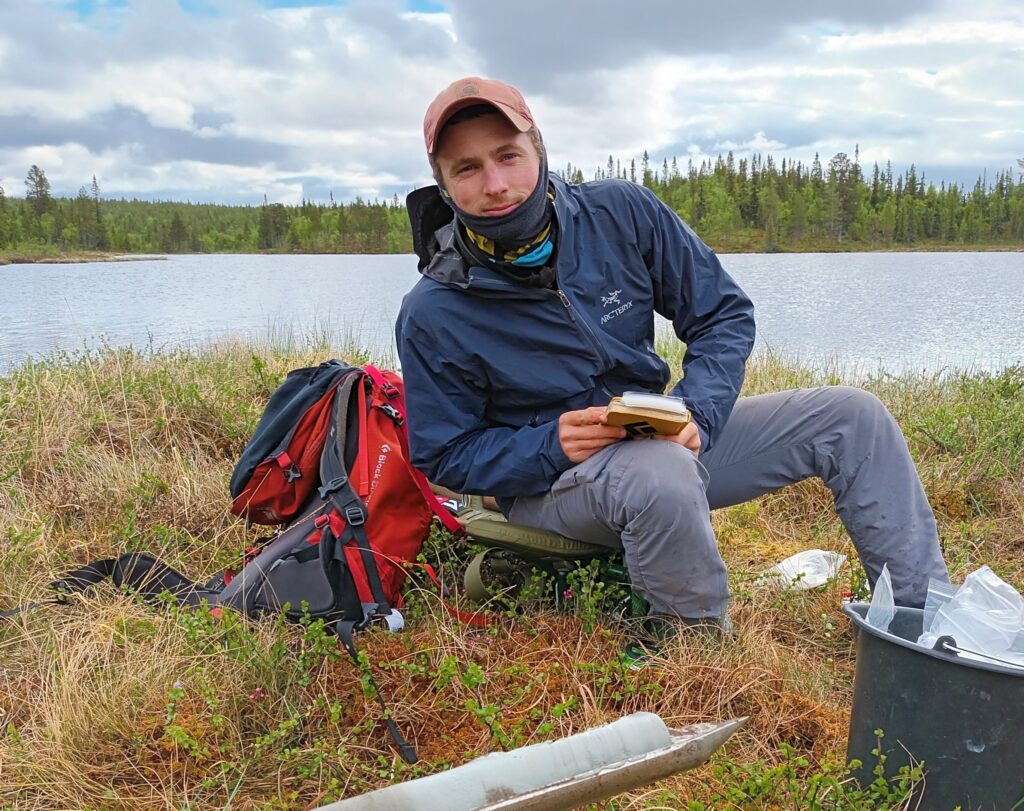
Johannes Hardeng
Floods and avalanches in a changing climate : Reconstructing frequency and seasonality from lacustrine records in southern Norway
In recent decades, extreme weather has become more frequent and intense, increasing the risk of climate-related hazards such as floods and snow avalanches. These events threaten lives, infrastructure, and society and are expected to intensify further as global temperatures rise. However, our understanding of the climatic drivers behind their frequency and seasonal variability is limited, primarily because instrumental records rarely span beyond the 20th century. To assess how flood and avalanche activity has varied in response to past climate fluctuations over millennial timescales, we must turn to geological archives that preserve evidence of past events. Lakes offer such archives: sedimentary layers deposited in response to catchment processes can be identified in sediment cores and used to reconstruct long-term records. The primary aim of this thesis is to reconstruct the Holocene frequency of floods and snow avalanches in southern Norway and to place the observed recent increase in these hazards within a long-term climate perspective. By understanding past change, we can better anticipate the future, an essential step toward effective climate adaptation. This thesis is based on new palaeoreconstructions from lakes in southernmost and southwestern Norway, analysed alongside existing records from western and eastern Norway and other palaeoclimate proxies. Together, these datasets are used to explore how large-scale climate dynamics have influenced the frequency and seasonality of floods and avalanches in the North Atlantic region.
Catchment characteristics were assessed through field-based quaternary geological mapping and remote sensing analyses (e.g., aerial imagery and LiDAR). Bathymetry was mapped using echo sounders, and CHIRP profiles assessed sediment distribution within the lakes. Sediment properties were characterised using high-resolution scanning techniques: magnetic susceptibility (MS), X-ray fluorescence (XRF), and CT scanning, supplemented by physical property analyses: dry bulk density (DBD), loss-on-ignition (LOI) and grain size. Once the sedimentological fingerprint of floods and avalanches was established, deposits were identified and quantified using two independent methods: rate of change (RoC) calculations from XRF data and threshold-based classification of CT data.
The thesis is based on three scientific papers. Paper I presents the first flood reconstruction from southernmost Norway and distinguishes between rainfall- and snowmelt-triggered floods based on sediment layers from Lake Lygne. By correlating the upper part of the sediment core with instrumental discharge data, we established that minerogenic layers correspond to rainfall floods, while organic layers reflect snowmelt floods. Rainfall was the predominant flood regime during the Holocene Thermal Maximum (>6000 cal yr BP) when the climate was characterised by warm summers and cold, dry winters. After ~6000 cal yr BP, a gradual shift toward cooler summers and milder, wetter winters favoured snowmelt floods, an evolution culminating during the Little Ice Age (LIA). The study identifies temperature as the primary driver of flood regime changes and suggests that ongoing warming, with warmer summers and winters, may lead to increased frequency of rainfall floods in both summer and winter. High-frequency fluctuations in flood activity on centennial timescales likely reflect shifts in atmospheric circulation patterns, particularly changes in the North Atlantic Oscillation.
Paper II presents a reconstruction of extreme floods from Lake Berse, a threshold lake in the Tovdalselva River system in southernmost Norway. During large floods, water from the Tovdalselva overtops the threshold and transports flood sediments directly into the lake. The reconstruction shows the frequency of extreme events was high during two periods: between 7000 and 5000 cal yr BP and from around 2300 cal yr BP to the present, with peak activity during the LIA. By comparing the sediment record with instrumental data from the past 120 years, a clear relationship emerges between flood activity, increased winter precipitation, and a positive NAO index. Similar patterns in older parts of the archive suggest that the link between atmospheric circulation and flood frequency has persisted throughout the Holocene, particularly during the Neoglacial period. The study shows that the most extreme floods in the region are governed by fluctuations in the westerlies and moisture transport from the North Atlantic.
Paper III reconstructs Holocene snow avalanche activity in western Norway based on lake sediments from Vatnasetvatnet. The lake is at the foot of a steep (30–50˚) north-facing slope, ideal for accumulating snow delivered by the predominant southwesterly winter storms. Avalanche activity was low during the Holocene Thermal Maximum but increased from around 4300 cal yr BP, peaking after 2300 cal yr BP and during the LIA. The results show that avalanche frequency is closely linked to winter climate and aligns with regional glacier reconstructions. Over millennial timescales, periods of increased avalanche activity coincide with the gradual, orbitally driven shift from cold, dry winters to milder, wetter ones. On shorter timescales, fluctuations in avalanche frequency are interpreted to reflect atmospheric circulation changes, particularly the strength of the NAO and the trajectory of winter storms.
Chapter 4 synthesises new and existing flood and avalanche records across southern Norway. The compilation demonstrates that both the frequency and type of events have varied systematically in response to changes in North Atlantic climate dynamics, particularly in winter temperature, precipitation, and atmospheric circulation. Three main phases are identified: (1) Early to mid-Holocene (10,000–6000 cal yr BP): Warm summers and cold, dry winters prevailed, limiting snow accumulation and resulting in low flood and avalanche frequencies. Some sites, such as Lake Lygne (Paper I), exhibit signs of intensified summer rainfall and rain-triggered floods, likely linked to an intensified hydrological cycle. (2) Mid-Holocene (6000–4200 cal yr BP): A gradual shift toward wetter winters led to increased flood and avalanche activity. Several archives indicate climatic instability, with significant regional differences and rapid shifts between rainfall- and snowmelt-dominated flood regimes (e.g., Paper I). This period also marks the first indications of NAO influence, particularly along the coast. (3) Late Holocene (after 4200 cal yr BP): The climate featured colder summers and warmer, wetter winters. Storminess intensified, leading to increased flood and avalanche frequency throughout the region, with peaks around 3000, 1500, and during the LIA. However, high-amplitude variability between centuries points to instabilities, likely related to subtle shifts in atmospheric circulation patterns.
The synthesis demonstrates that extreme events in southern Norway are closely tied to winter climate and atmospheric circulation. Future warming will likely result in more frequent rainfall floods, particularly in low-lying catchments, while snowmelt-related floods may decline due to reduced snowpack.